|
Combining advanced NVIDIA integrated graphics technology along with an Intel
Core 2 Duo processor, the 13-inch Apple MacBook Pro is faster than ever and will
keep you working longer away from power cords with an enhanced battery life of
up to 10 hours of battery life. As with previous models, the new MacBook Pro
features a precision unibody enclosure crafted from a single block of aluminum,
creating a thin and light mobile computing workhorse (less than 1 inch thin and
just 4.5 pounds) that's also highly durable. And it includes a 13.3-inch,
LED-backlit glass display (instead of an LCD panel) as well as a glass trackpad
that doesn't include a button (for larger tracking area) that features Apple's
Multi-Touch technology.
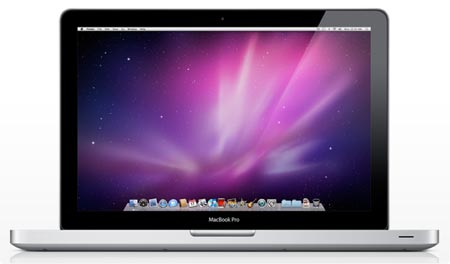
The 13-inch unibody MacBook Pro.
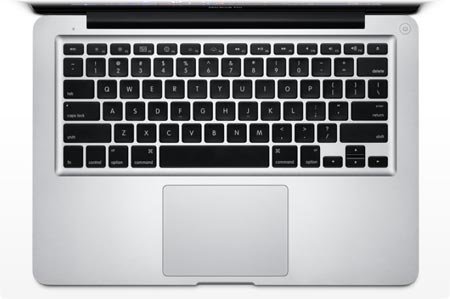
The new energy-efficient architecture in the
13-inch MacBook Pro gives you up to 10 hours of battery life on
a single charge.
With 4 GB of memory and a 250 GB hard drive now standard, this is the
most powerful 13-inch MacBook Pro yet. It also comes pre-loaded with
Apple's Mac OS X 10.6 Snow Leopard operating system--an operating system
custom-designed for the advanced technology inside--and it also comes
with the iLife '09 suite of applications, including iPhoto, iMovie,
GarageBand, and iTunes.
Specification Highlights
- 13.3-inch LED-backlit glossy widescreen display
with edge-to-edge, uninterrupted glass (1280 x 800-pixel
resolution).
- 2.4 GHz Intel Core 2 Duo dual-core processor
with 3 MB shared L2 cache for excellent multitasking
- NVIDIA GeForce 320M graphics processor with 256
MB of DDR3 SDRAM shared with main memory.
- 250 GB Serial ATA hard drive (5400 RPM)
- 4 GB installed RAM (1066 MHz DDR3; supports up
to 8 GB)
- 8x slot-loading SuperDrive with double-layer
DVD support (DVD±R DL/DVD±RW/CD-RW)
- Built-in iSight camera for video chatting
- Wi-Fi wireless networking (based on 802.11n
specification; 802.11a/b/g compatible)
- Gigabit Ethernet wired networking (10/100/1000)
- Bluetooth 2.1 + EDR (Enhanced Data Rate) for
connecting with peripherals such as keyboards, mice and cell phones
- Two USB 2.0 ports, one FireWire 800 port
- SD card slot
- MMini DisplayPort video output with optional
adapters for DVI, VGA, dual-link DVI, and HDMI output
- Multi-Touch trackpad for precise cursor control
with support for inertial scrolling, pinch, rotate, swipe,
three-finger swipe, four-finger swipe, tap, double-tap, and drag
capabilities
- Full-size backlit keyboard
- Stereo speakers with subwoofers
- Dimensions: 12.78 x 8.94 x 0.95 inches (WxDxH)
- Weight: 4.5 pounds
- Up to 10 hours of battery life
- Mac OS X v10.6 Snow Leopard
- Meets Energy Star 5.0 requirements
What's in the Box
MacBook Pro, display cleaning cloth, 85W MagSafe Power Adapter, AC wall
plug, power cord, software DVDs, printed and electronic documentation
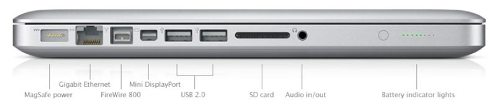
The ports on the left side of the 13-inch MacBook
Pro.
Key Features
A New Standard for Performance and Portability
The new 13-inch MacBook Pro features advanced NVIDIA integrated graphics
technology along with a faster Intel Core 2 Duo processor. That makes for the
ultimate combination of performance, portability, and battery life--up to 10
hours--without adding an ounce to the slimmest, lightest MacBook Pro.
With the 1066 MHz frontside bus and 3 MB of shared L2 cache of the Intel Core
2 Duo processor, all your applications will run faster and more efficiently than
you thought possible. The 13-inch MacBook Pro also features the new NVIDIA
GeForce 320M integrated graphics processor with 48 processing cores--three times
as many as before. This results in a huge difference when using 3D games and
graphics-intensive applications. And when you're not, you'll benefit from a new
energy-efficient architecture that uses up to 40 percent less power for everyday
tasks like writing email and surfing the web.
Unibody Design
Traditionally, notebooks are made from multiple parts. With the MacBook Pro all
of those parts with just one part--the breakthrough unibody enclosure. Every
MacBook Pro starts its life as a single block of aluminum, which is precisely
machined into the basic unibody design. Another pass and the unibody takes
shape. Another, and the integrated keyboard emerges. When you pick up a new
MacBook Pro, you immediately notice the entire enclosure is thinner and lighter.
And it feels strong and durable--perfect for life inside (and outside) your
briefcase or backpack.
LED-Backlit Display
LCD displays typically use cold cathode fluorescent lamps, or CCFLs, to create
light and project a picture onto a screen, and this creates two problems--the
lamps require more space and they take more time to warm up to full brightness.
The MacBook Pro uses LED backlight technology to create the same amount of
brightness in less space. And unlike fluorescent lamps, an LED backlight reaches
maximum brightness instantly. Finally, a new, smaller iSight camera is concealed
behind the display for quick access to video chats and snapping pics for
uploading to social networks.
Additionally, conventional CCFL displays use mercury to create a backlight and
arsenic to prevent irregularities in the glass. The LED-backlit display on the
MacBook Pro, on the other hand, is both mercury- and arsenic-free. LED backlight
technology also conserves energy: This display requires up to 30 percent less
power than a CCFL display.
Buttonless Multi-Touch Trackpad
With no button on the durable glass trackpad, there's more room to track and
click--left, right, center, and everywhere in between. Without a separate
button, the spacious trackpad gives your hands plenty of room to move on the
large, silky glass surface. It also incorporates Multi-Touch gestures--including
swipe, pinch, rotate, and four-finger swipe--and even more natural inertial
scrolling--an intuitive way to scroll through large photo libraries, lengthy
documents and long web sites. If you're coming from a right-click world, you can
right-click with two fingers or configure a right-click area on the trackpad.
Long-Lasting Battery
The new energy-efficient architecture in every MacBook Pro, along with automatic
graphics switching, gives you dramatically longer battery life. On a single
charge, the battery in the new 13-inch MacBook Pro lasts up to 10 hours. And
you'll get up to 1000 full charge and discharge cycles--that's nearly three
times the lifespan of typical notebook batteries. Advanced chemistry and
Adaptive Charging allow the battery to maintain charging capabilities longer and
determine the optimal way to charge the battery's cells. Because the battery
lasts up to five years, MacBook Pro uses just one battery in the same time a
typical notebook uses three. That makes for less waste. And that, in turn, makes
for one environmentally friendly battery.
Environmental Considerations
Apple has worked hard to eliminate many of the toxins that are a common part of
computer manufacturing. Apple engineers removed the majority of brominated flame
retardants (BFRs) and polyvinyl chloride (PVC) from circuit boards, internal
cables, connectors, insulators, adhesives, and more in the MacBook Pro.
Because Apple makes both the hardware and the software for the MacBook,
they're designed to work together to produce a smarter product that uses less
electricity. For instance, to reduce energy consumption, the hard drive spins
down automatically when inactive. MacBook Air also decides which processor--CPU
or GPU--is best suited to efficiently perform a task. The LED-backlit display in
the MacBook Pro is another feature that plays an important part in conserving
energy, consuming 30 percent less power than conventional LCD displays. And the
display is designed to dim when you enter a darkened room.
The MacBook Pro meets the stringent low power requirements set by the EPA,
giving it ENERGY STAR qualification. ENERGY STAR 5.0 sets significantly higher
efficiency limits for power supplies and aggressive limits for the computer's
typical annual power consumption.
Also, every MacBook Pro model has earned the highest rating of EPEAT Gold.
The Electronic Product Environmental Assessment Tool, or EPEAT, evaluates the
environmental impact of a product based on how recyclable it is, how much energy
it uses, and how it's designed and manufactured.
|